Microsoft published Visual Studio 2010 Service Pack 1 Beta on 03-Dec-2010. To download click here.
Friday, December 17, 2010


Monday, November 15, 2010
jQuery 1.4.4 Released
The fourth minor release of jQuery 1.4 is now available — less than one month after 1.4.3 was released.
Unsurprisingly, version 1.4.4 is primarily a set of bug fixes following feedback from the user community. There is only one new feature…
jQuery.fadeToggle()
The .fadeToggle() method provides fade-in and fade-out animation. If an element is visible, it’s opacity is reduced and, when it reaches zero, the display property is set to none so the element disappears from the page layout.
Calling .fadeToggle() on an invisible element (where display:none is set) makes the item visible and fades it back in.
Major bug fixes
If you’ve been struggling to make your code work, you’ll be pleased to know that the following issues have been fixed:
- The .width() and .height() of hidden elements are reported correctly (in some situations, previous versions would return negative values). This is likely to be the cause of most 1.4.3 to 1.4.4 update compatibility issues.
- Host and protocol names are now compared case-insensitively when determining whether an Ajax request is local or remote.
- Computed CSS for elements now returns “auto” consistently rather than an empty string.
- A function bound to the document ready event will now fire once (it was firing twice).
- The .removeData() failure has been fixed.
- The attribute not equals selector ([foo!=bar]) now works in Firefox.
- Child (>), next sibling (+), and previous sibling (~) selectors now work when combined with pseudo-selectors (such as :last).
- .show() will not fail if .hide() was initially called on a hidden element.
Links
Grab jQuery 1.4.4 from:
- Uncompressed version (179kB) –
http://code.jquery.com/jquery-1.4.4.js - Minified version (26kB gzipped / 76kB non-gzipped) –
http://code.jquery.com/jquery-1.4.4.min.js - Microsoft CDN –
http://ajax.microsoft.com/ajax/jquery/jquery-1.4.4.min.js - jQuery 1.4.4 documentation –
http://api.jquery.com/category/version/1.4.4/
Thursday, August 5, 2010
Visual Studio LightSwitch Beta
THE SIMPLEST WAY TO BUILD BUSINESS APPLICATIONS FOR DESKTOP AND CLOUD.
Microsoft Visual Studio LightSwitch Beta helps you solve specific business needs by enabling you to quickly create professional-quality business applications, regardless of your development skills. LightSwitch is a new addition to the Visual Studio family. Visit this page often to learn more about this exciting product.
Visual Studio LightSwitch Beta will be available on August 23.
You can find introduction to LightSwitch video here.
Microsoft Visual Studio LightSwitch Beta helps you solve specific business needs by enabling you to quickly create professional-quality business applications, regardless of your development skills. LightSwitch is a new addition to the Visual Studio family. Visit this page often to learn more about this exciting product.
Visual Studio LightSwitch Beta will be available on August 23.
You can find introduction to LightSwitch video here.
Wednesday, July 7, 2010
Microsoft Introduces IIS Express
Developers today build and test ASP.NET sites and applications using one of two web-servers:
IIS Express will work with VS 2010 and Visual Web Developer 2010 Express, will run on Windows XP and higher systems, does not require an administrator account, and does not require any code changes to use. You will be able to take advantage of it with all types of ASP.NET applications, and it enables you to develop using a full IIS 7.x feature-set.


Two cool things to notice above:
- The ASP.NET Development Server that comes built-into Visual Studio
- The IIS Web Server that comes built-into Windows
IIS Express will work with VS 2010 and Visual Web Developer 2010 Express, will run on Windows XP and higher systems, does not require an administrator account, and does not require any code changes to use. You will be able to take advantage of it with all types of ASP.NET applications, and it enables you to develop using a full IIS 7.x feature-set.
How Things Work Today
Before I get into the details of IIS Express, let’s first quickly review how the ASP.NET Development Server and IIS options work today.
ASP.NET Development Server
Visual Studio’s built-in ASP.NET Development Server (also known as “Cassini”) has the benefit of being light-weight and easy to quickly run. It doesn’t listen on remote ports (which makes it easier to get approved for many corporate security environments), works even when you are running under a non-administrator account, and doesn’t require a separate installation step.
The fact that it is so easy to get running is a huge positive of it – and the reason it is the default web-server used by ASP.NET projects in Visual Studio when you press F5 to run them:

The downside with the ASP.NET Developer Server, though, is that it does not support a full set of web-server features. For example, it doesn’t support SSL, URL Rewriting Rules (like the SEO URL Rewrite Rules I blogged about here), Custom Security Settings, and other richer features now offered with IIS 7.
IIS Web Server
IIS is the other option developers use when running and testing their applications with Visual Studio. You can configure a web project within Visual Studio to use IIS by right-clicking on the project and pulling up its properties (and then by clicking on the “Web” tab within the properties window)":

Using IIS as your development server allows you to take full advantage of all web-server features (SSL, URL Rewrite Rules, etc). IIS is a full-fledged web-server – which means you’ll get an experience closer to what it will work like when you deploy the application on a production server.
The downside with using the IIS option today, though, is that some companies don’t allow full web-servers to be installed on developer machines. IIS also requires administrator account access to setup and debug projects. Different versions of Windows also support different versions of IIS. For example, if you are running on Windows XP you have to use the IIS 5.1 web-server that comes with it – which doesn’t support all the new features of IIS 7.x. Configuring a web project within VS to use IIS also requires some extra installation and configuration steps.
IIS Express – The Best of Both Options
We have been working on a new flavor of IIS 7.x that is optimized for developer scenarios that we are calling “IIS Express”. We think it combines the ease of use of the ASP.NET Web Server with the full power of IIS. Specifically:
- It’s lightweight and easy to install (less than 10Mb download and a super quick install)
- It does not require an administrator account to run/debug applications from Visual Studio
- It enables a full web-server feature set – including SSL, URL Rewrite, Media Support, and all other IIS 7.x modules
- It supports and enables the same extensibility model and web.config file settings that IIS 7.x support
- It can be installed side-by-side with the full IIS web server as well as the ASP.NET Development Server (they do not conflict at all)
- It works on Windows XP and higher operating systems – giving you a full IIS 7.x developer feature-set on all OS platforms
IIS Express (like the ASP.NET Development Server) can be quickly launched to run a site from a directory on disk. It does not require any registration/configuration steps. This makes it really easy to launch and run for development scenarios.
VS 2010 IntegrationWe are enabling IIS Express so that it can be easily used with Visual Studio 2010. You’ll be able to configure VS 2010 to use it instead of the ASP.NET Web Server as the default web-server on ASP.NET Projects. Like the ASP.NET Development Server today, you won’t need to register a site or virtual directory to use IIS Express. It will support the same usage-model as the ASP.NET Development Server today – just with more feature support.
When you press F5 to run an ASP.NET project, Visual Studio can automatically launch IIS Express and use it to run/debug the application (no extra configuration required). Like the ASP.NET Web Server, IIS Express will show up in your task-bar tray when running:

You can right-click and click “exit” on the icon above to quickly shutdown IIS Express. You can also right-click and pull up a list of all sites running with it, as well as the directory location and .NET versions they are running under:
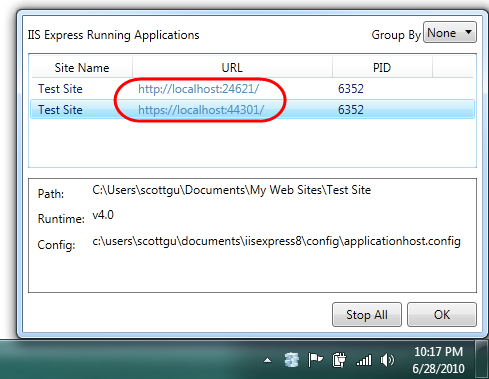
Two cool things to notice above:
1) The “Test Site” we are running, as well as IIS Express itself, live under the c:\users\[username] folder on disk. This enables non-administrator usage of IIS Express and sites – and enables a bunch of scenarios not possible with the full IIS today (including the ability to run IIS Express in both a locked-down enterprise environment as well as a locked-down school shared computer environment).
2) The “Test Site” we are running above using IIS Express supports both HTTP and HTTPS access. IIS Express automatically installs a “self-signed certificate” and enables URL ACLs and SSL Certificates for ports so that developers (running as non-administrators on a machine) can use SSL without needing to elevate their accounts or setup any additional configuration. This enables you to configure secure pages within your applications (like Logon forms) for SSL and run/test them at development time just like they’ll work on your real web-server.
IIS 7.x Feature Set
IIS Express is as easy to run and use as the ASP.NET Web Server you are familiar with today. But because IIS Express is based on the IIS 7x codebase, you have a full web-server feature-set that you can use. This means you can build and run your applications just they’ll work on a real production web-server. In addition to scenarios like SSL, you can take advantage of the IIS 7.x URL Rewriter module, Media Extensions, Dynamic Compression, Advanced Logging, Custom Security and other rich modules now available.
In addition to supporting ASP.NET, IIS Express also supports Classic ASP and other file-types and extensions supported by IIS – which also makes it ideal for sites that combine a variety of different technologies.
Summary
IIS Express makes it even easier to build, run and test web applications. It works with all versions of ASP.NET and supports all ASP.NET application types (including obviously ASP.NET Web Forms and ASP.NET MVC applications). Best of all – you do not need to change any code to take advantage of it. You’ll be able to optionally use it with all your current projects today.
Microsoft WebMatrix
-
IIS Developer Express: A lightweight web-server that is simple to setup, free, works with all versions of Windows, and is compatible with the full IIS 7.5.
-
SQL Server Compact Edition: A lightweight file-based database that is simple to setup, free, can be embedded within your ASP.NET applications, supports low-cost hosting environments, and enables databases to be optionally migrated to SQL Server.
-
ASP.NET “Razor”: A new view-engine option for ASP.NET that enables a code-focused templating syntax optimized around HTML generation. You can use “Razor” to easily embed VB or C# within HTML. It’s syntax is easy to write, simple to learn, and works with any text editor.
Microsoft introduces a new lightweight web development tool that also integrates the above technologies, and makes it even easier for people to get started with web development using ASP.NET. This tool is free, provides core coding and database support, integrates with an open source web application gallery, and includes support to easily publish/deploy sites and applications to web hosting providers.
Microsoft calling this new tool WebMatrix, and the first preview beta of it is now available for download.
What is in WebMatrix?
WebMatrix is a 15MB download (50MB if you don’t have .NET 4 installed) and is quick to install.
The 15MB download includes a lightweight development tool, IIS Express, SQL Compact Edition, and a set of ASP.NET extensions that enable you to build standalone ASP.NET Pages using the new Razor syntax, as well as a set of easy to use database and HTML helpers for performing common web-tasks. WebMatrix can be installed side-by-side with Visual Studio 2010 and Visual Web Developer 2010 Express.
Note: Razor support within ASP.NET MVC applications is not included in this first beta of WebMatrix – it will instead show up later this month in a separate ASP.NET MVC Preview - which will also include Visual Studio tooling support for it.
For more information please visit http://weblogs.asp.net/scottgu/archive/2010/07/06/introducing-webmatrix.aspx
Wednesday, May 12, 2010
Pinning Projects and Solutions with Visual Studio 2010
Scott Guthrie did a blog post that covers a very small, but still useful, feature of VS 2010 – the ability to “pin” projects and solutions to both the Windows 7 taskbar as well VS 2010 Start Page.

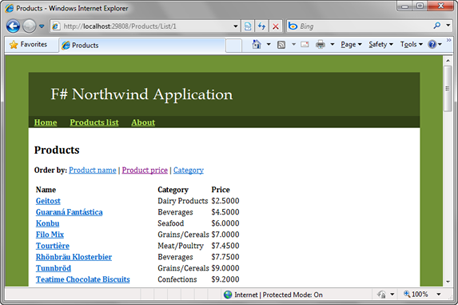
Creating MVC web applications in F#
Here is the nice blog by Tomas Petricek on developing MVC web applications in F# using ASP.NET. http://tomasp.net/blog/fsharp-mvc-web.aspx
Subscribe to:
Posts (Atom)